“There is evidence that the Early Church enjoyed significant leadership by women. However, it was not long before the Empire’s dominant male-centred culture reshaped the Church. The reshaped Church then largely reshaped its interpretation of women and therefore of Mary’s role,” says Peter Catt, President of APCVA.
We know the scene: the room, variously furnished,
almost always a lectern, a book; always
the tall lily.
Arrived on solemn grandeur of great wings,
the angelic ambassador, standing or hovering,
whom she acknowledges, a guest.
But we are told of meek obedience. No one mentions
courage.
The engendering Spirit
did not enter her without consent.
God waited.
She was free
to accept or to refuse, choice
integral to humanness.
Denise Levertov, “From Annunciation”
No one mentions courage…
The Bible readings over the last two Sundays have included fleeting references to the fact that Mary, the mother of Jesus, and other women, were present with the male disciples at the Ascension of Jesus (Acts 1.6-14) and during the events that took place on the Day of Pentecost (Acts 2.1-21).
The Gospels are meaning-dense documents, the products of years of reflection and of the telling and retelling of stories that inspired the early followers of The Way of Jesus. Every detail in those stories is deliberately placed to convey information of deep significance. This means that fleeting mentions, which may seem to be of little consequence because of their brevity, are in fact pointing us towards highly significant insights. The deliberate mention of Mary in these pivotal texts by the writer of Luke-Acts invites us to consider afresh what role she plays in our understanding of the faith.
The writer of The Gospel according to John, also uses a narrative device to accentuate the role Mary plays in the Church. As Jesus hangs on the cross, the writer draws the reader into an interaction between Jesus, Mary and the beloved disciple (John 19.25-27). One of the suggestions that scholars make regarding the identity of the beloved disciple is that the character represents “every disciple”, including you and me. So, when Jesus says of Mary to the beloved disciple, “Behold your mother”, the writer is conveying something profound in terms of the role Mary played for the Johannine community.
Francis of Assisi, among others, referred to Mary as the Spouse of the Spirit, linking her presence at Pentecost to The Annunciation (Luke 1.26-38), the event through which she develops a profound relationship with the Spirit. Her participation in the Pentecost experience can be seen as a renewal of the bond that was formed when she agreed to partner with the Spirit at The Annunciation; linking the beginning of the story, as it pertains to the physical presence of Jesus, to the end.
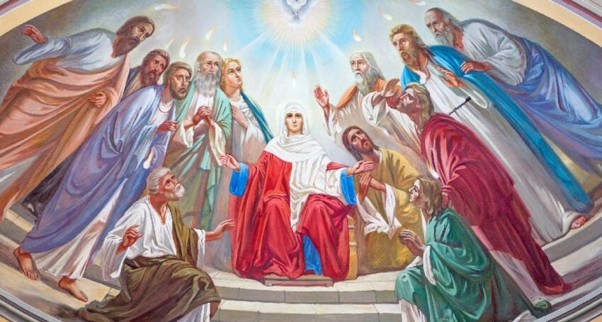
Orthodox iconography reminds we westerners, particularly those of us touched by the Reformation, that large portions of the Church have continually honoured Mary’s central role in the story of God’s love for humanity. Icons of the Ascension and Pentecost almost universally place her at the centre of the group of disciples. This image of the fresco found in the Russian Orthodox Cathedral of Holy Trinity, Jerusalem displays this classic arrangement. While many icons of Mary with baby Jesus show her holding her hands in what is known as the Orans position, the orientation of the hands adopted by priests as they pray the Eucharistic Prayer.
And yet, the Orthodox, along with the rest of the Church, have struggled to fully embrace the counter-cultural implications that Mary’s leadership carries for the way humanity conducts itself. There is evidence that the Early Church enjoyed significant leadership by women. However, it was not long before the Empire’s dominant male-centred culture reshaped the Church. The reshaped Church then largely reshaped its interpretation of women and therefore of Mary’s role. As Levertov notes, “… we are told of meek obedience. No one mentions courage…“
We are all creatures of our time and culture. The Gospel continually stands before us inviting us to reflect on how we can challenge and transform the culture so that God’s Commonwealth can come more fully on earth as in heaven.
First published in the Cathedral Precinct eNews on 25 May 2026
Peter Catt, President of APCVA