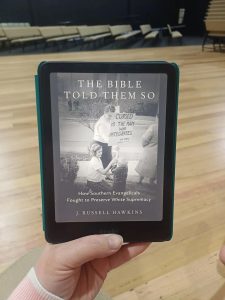
I’ve been trying to learn as much as I can about the history of racism in the US. Being an Aussie who went to a very conservative Christian school, it’s not a topic I learned about, and I’m realising that was possibly intentional.
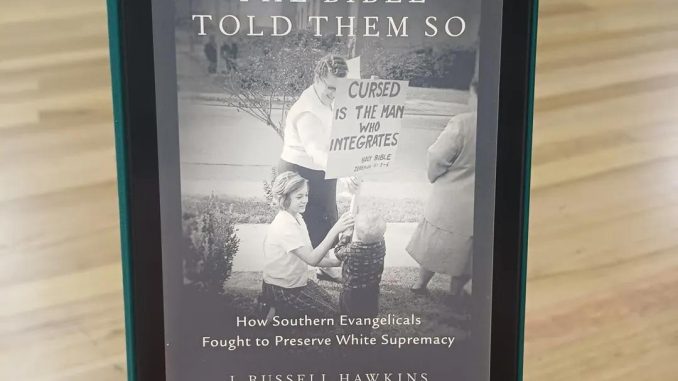
This book examines written communications between church attendees and ministers in Baptist and Methodist churches during desegregation in the 1950s and 1960s. The ministers were largely supportive of desegregation, and the attendees were largely against it.
I was shocked to learn just how much southern Christians used Bible verses in the early days of integration to defend their stance in keeping Black and white churches separate. I’ve heard people using Bible verses in the same way and was never sure where that came from. Now I know.
The author also discusses how these Christians pivoted from heavy use of Bible verses to the idea of colour-blindness: not acknowledging their complicity in racism and avoiding the conversation altogether in order to stay comfortable and never accountable. The racism was passed down multiple generations in First Baptist Church Columbia, South Carolina, with slightly different versions.
As it became less socially acceptable to be overtly racist, church members changed their approach publicly, but still held the same beliefs: that white and black Christians should remain separate in all aspects of their lives because they believed that was God’s will.
What struck me most about this is the commonalities with present-day churches and how they often approach LGBTQ+ Christians: using out-of-context Bible verses to justify exclusion. The cruelty in the context of racism would be obvious to most Australian Christians now, but there still remains an underlying belief in the need for conformity and sameness, something I believe we need to be working to change.
This is an important book, and I think it shows firstly how racism is definitely something the western white church has a problem with (and has for several generations), and secondly how it morphs in ways that become more socially tolerated. Ignoring the issues and not acknowledging the part we’ve played doesn’t make it go away.
Review by Maree Walker
You can read more by Maree on her Maree’s Musings substack or follow her on Threads at mareesmusings.